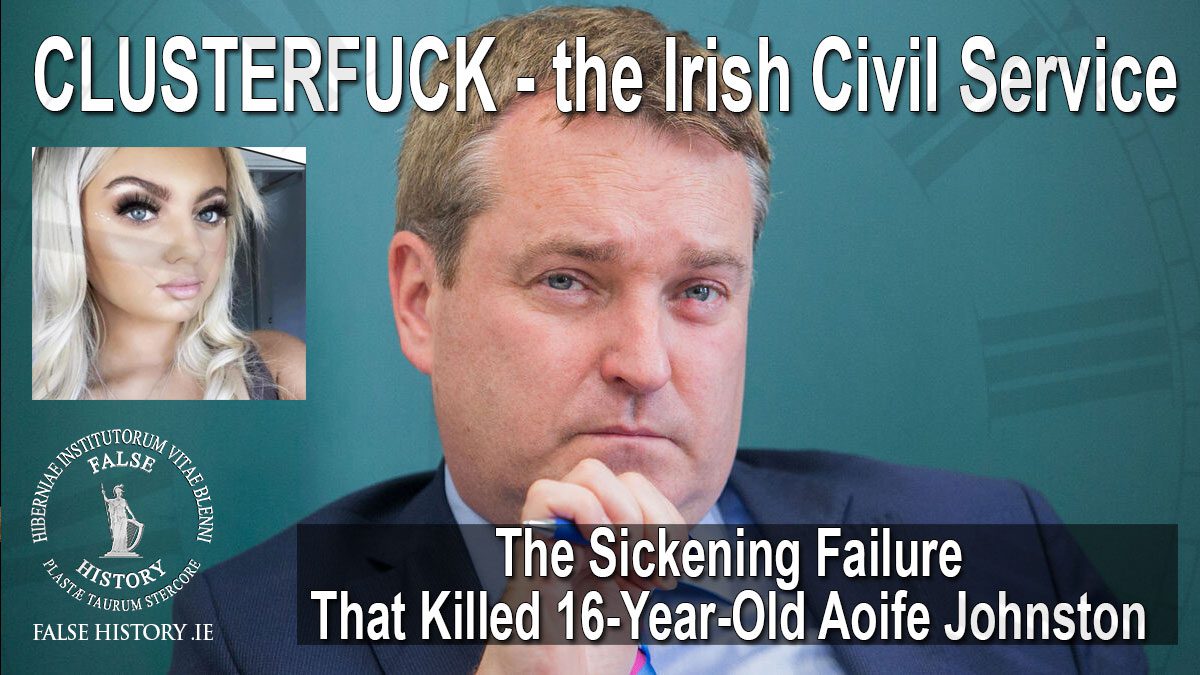
The term “clusterfuck” was not coined to describe the Irish civil service — but you’d be forgiven for thinking it was. I am sickened by the treatment, or rather the non-treatment, that led to the death of sixteen-year-old Aoife Johnston in University Hospital, Limerick. Every time a preventable death occurs, the system performs its ritual of remorse, issues promises of improvement, and then slides straight back into dysfunction until the next needless tragedy. Aoife wasn’t failed by chance, she was failed by a system that has normalised failure.
If the Irish State were a company, it would be liquidated before lunch and the directors barred for life. But because it is a bureaucracy answerable mostly to itself, its failures simply harden into custom, its scandals become traditions, and its apologies become templates for the next round of calamity.
Ireland’s civil service has perfected a peculiar art: catastrophic incompetence delivered with absolute self-confidence. There is no failure so large it cannot be reframed as a “systems issue,” no tragedy so avoidable it cannot be smothered in waffle about “learning lessons,” and no department so dysfunctional that it cannot be rewarded with a larger budget to do more of the same.
Ireland should just call its civil service what it is: the Irish Clusterfuck. Maybe then our politicians would stop coasting on a tsunami of catastrophe and start doing the job they’re paid for, reforming a system that fails people with industrial consistency.
Aoife Johnston went first to a GP, a family doctor who correctly suspected sepsis. They wrote a clear referral letter to the Emergency Department at University Hospital, Limerick, explicitly flagging “query sepsis.” That letter should have guaranteed immediate triage, urgent assessment, and the rapid initiation of treatment. Instead, it became the starting pistol for the latest instalment in the HSE’s ongoing, daily parade of clusterfucks.
The ED she was sent into was already in meltdown: dangerously overcrowded, chronically understaffed, and operating in conditions that would shame a field hospital. This chaos was not random, it was engineered. Smaller emergency departments in the region had been closed, following a government plan that said UHL could only absorb their caseload after its own capacity was expanded. Predictably, the closures went ahead. Equally, predictably, the promised expansion never did.
The result? Every emergency in the region funnelled into a single, overloaded department, and Aoife walked straight into the disaster it created.
She waited over an hour before even seeing a triage nurse. Triage is supposed to assess urgency and prioritise the sickest patients first. When Aoife was finally examined, she was correctly classified as Category 2, a level that requires a doctor to see the patient within ten minutes. That should have triggered immediate action. It didn’t. In fact, it took 10 hours before Aoife was treated for her symptoms, alas it was too late.
The official report into Aoife’s death did not blame the medical staff, they were working in conditions that would break most people, but it was unequivocal about the real failure: senior management decisions were never properly communicated to the nurse managers on the ground.
While the ivory tower was busy producing glossy, high-level “escalation plans” and theoretical protocols for what to do when the ED became unsafe, including how to treat patients forced to bypass Resus because of overcrowding, none of it filtered down to the people actually running the floor.
Plans existed on paper.
Training did not.
Communication did not.
Operational clarity did not.
In other words: the executives had a playbook, but the frontline staff, the very people expected to execute it, were never told how to use it. That isn’t an exception; it’s the defining characteristic of the Irish civil service: aloof administrators with big titles, big salaries, and no actual management ability.
Robert Watt was brought in on one of the highest salaries in the Irish public service, a package justified on the promise that he would finally bring order to the chaos of the HSE. Instead, the system remains as dysfunctional as ever. Overcrowding is worse, accountability is still non-existent, and preventable tragedies continue to occur with metronomic regularity. If his mandate was to “sort out the mess,” then by any reasonable standard, he has failed — spectacularly.
Robert Watt is on a salary now approaching €326,000, backed by a gold-plated pension, potential added years, and a six-figure severance entitlement should he ever be removed. It is a compensation bundle designed for a reformer of exceptional calibre, someone expected to turn a dysfunctional health system into a functioning one. Instead, the chaos has deepened, the scandals have multiplied, and the HSE remains the same bloated, unaccountable labyrinth it always was. For a salary of that size, the taxpayer is entitled to expect results. What they have received instead is failure on a very expensive scale. Watt a clusterfuck.
EJ
Refs
The Frank Clarke Report – independent investigation (pdf)
