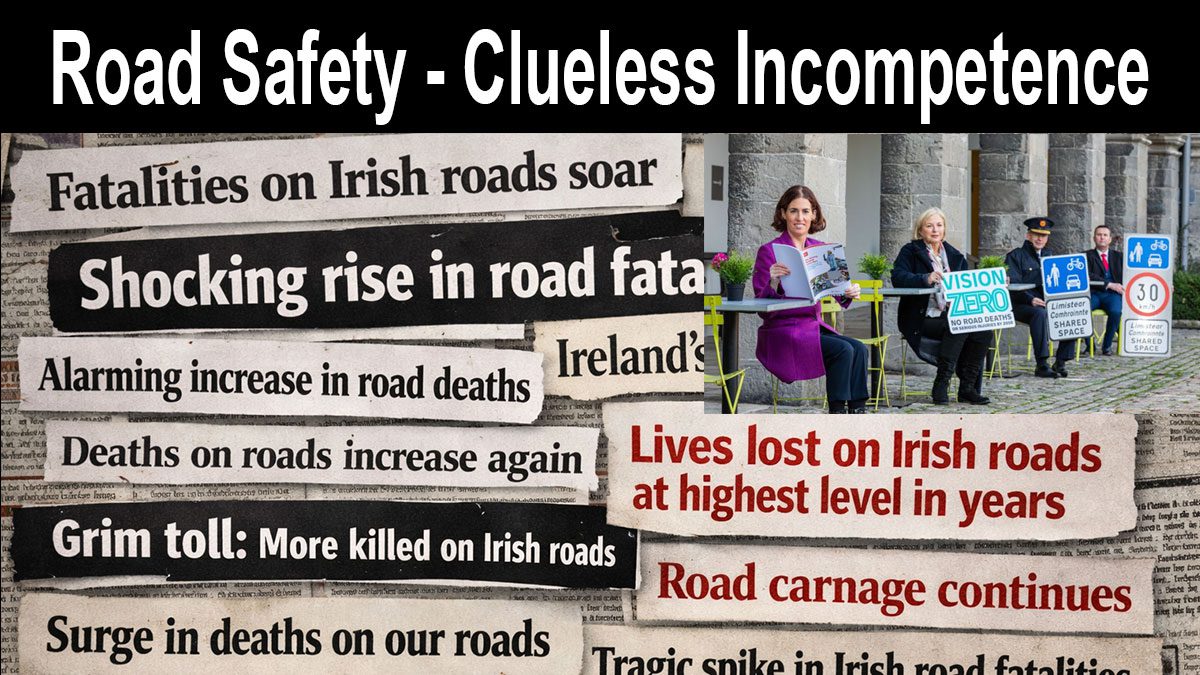
If the Irish Road Safety Authority, RSA, oversaw aviation safety, everyone would be afraid to fly. Ireland has the most dangerous road network in Europe, operated and managed by the most incompetent system of road management in the world. If the RSA ran aviation, safety wouldn’t soar, it would nosedive under the weight of its own sanctimony.
Decades of research show that when something goes wrong, we instinctively blame people, not circumstances. If someone else messes up, we think, “That was their fault.” But when we mess up? Suddenly it’s “It was dark,” “The road was dangerous,” or “That other person came out of nowhere.” In short, we see other people’s mistakes as character flaws and our own as bad luck. This is our natural way of thinking, but it is a fatal flaw in the human psyche that bedevils incompetent safety organisations, like the Irish Road Safety Authority.
Picture this: You’ve just boarded your Aer Lingus flight from Dublin to New York. The engines hum, the cabin crew smile, and then the captain’s voice crackles over the intercom:
“Ladies and gentlemen, welcome aboard. The Irish Road Safety Authority reminds you that 94% of plane crashes are caused by pilot error, so please keep your seatbelts fastened, and maybe say a prayer for our self-control.”
If that line makes your stomach drop, congratulations, you’ve just glimpsed what aviation would look like under RSA, the organisation that has perfected the art of blaming individuals while ignoring everything else that makes roads, and potentially skies, unsafe.
The RSA’s worldview is simple: humans are the problem.
Drivers, like naughty schoolchildren, must be scolded into submission. Campaigns ooze with paternalistic slogans: “Slow Down,” “Don’t Drink and Drive,” “Wear a Seatbelt.” Sensible messages, sure, but they’re also a smokescreen for a deeper institutional laziness.
The real culprits, dangerous road design, inadequate maintenance, inconsistent speed limits, and chronic underinvestment, rarely make the cut. Because fixing roads costs money. Scolding drivers is free.
Now imagine the RSA taking that approach to aviation safety.
Every plane crash would be followed by a sombre press release:
“The pilot was flying too fast for conditions.”
“We remind all pilots to obey the airspeed limit.”
“Aviation is 99% safe when everyone behaves.”
Forget black box analysis or design reviews. No mention of faulty altimeters or ice accumulation. The entire system would hinge on moral lectures.
And the RSA would absolutely love an opportunity to plaster slogans across aircraft fuselages:
“Think Before You Stall.”
“Your Family Wants You to Land Safely.”
“Speed Kills — Even at 30,000 Feet.”
Meanwhile, the Department of Transport would announce another “pilot awareness week,” during which officials in hi-vis vests would hand out leaflets on “responsible airmanship” at Shannon Airport.
One of the RSA’s signature moves is to treat the physical world as an afterthought. Roads don’t kill people; people kill people. So, what if a junction is designed like an Escher drawing? The driver should have been more careful.
Under RSA-style aviation safety, we’d see:
- Runways with trees at the end — “The pilot should have braked sooner.”
- Navigation beacons switched off to save electricity — “Pilots should rely on intuition.”
- Air traffic controllers replaced by posters reminding pilots to “Share the Sky.”
And if the radar fails?
“Technology is no substitute for vigilance.”
The RSA’s dream isn’t safety, it’s compliance.
They’d install speed cameras in the clouds and ticket planes for exceeding 800 km/h. Airside Garda checkpoints would breathalyse pilots mid-boarding. A new ad campaign would warn:
“Flying high? Don’t get high before you fly.”
Because when your worldview begins and ends with “personal responsibility,” satire starts writing itself.
Final Approach
If the Irish Road Safety Authority ran aviation, you’d see it in the skies:
Planes grounded until pilots attend the “Safe Sky” workshop.
Warning stickers on cockpit dashboards: “This aircraft kills when misused.”
Runways narrowed “to encourage careful landings.”
And passengers? They’d take the ferry. Because no one would trust a system that treats professionals like children and safety as a sermon.
The miracle of modern aviation is that it learned long ago: people make mistakes, but systems can be built to catch them.
If only the RSA could stop wagging its finger long enough to learn the same lesson.
The RSA has faced repeated criticism for running patronising, moralising, and shock-based adverts that blame individual drivers rather than addressing systemic safety flaws.
Key examples include:
“Lose Your Licence, Lose Your Independence” – condemned as ableist for implying non-drivers are burdens.
“Blood on Your Hands” – a drink-driving ad where characters’ hands literally drip with blood; powerful but moralising.
“Get This Season’s Killer Look” – a seatbelt misuse ad mixing fashion imagery and graphic injury scenes.
“Dangerous Driving Behaviours” (radio) – sensational “autopsy”-style spots that stereotype young men as killers.
“Rural Speed – Daily Grind” – portrays ordinary commuters as thoughtless speeders on repeat until they crash.
Critics argue these campaigns infantilise drivers and rely on fear and guilt instead of tackling dangerous infrastructure, design flaws, or enforcement consistency, epitomising the RSA’s behavioural blame culture.
What Road Safety Could Learn from Aviation
If road safety adopted aviation’s model, it would:
Treat every crash as a data-rich event, not a moral failure.
Analyse infrastructure, environment, and policy with the same rigour as individual behaviour.
Implement systemic safeguards, like forgiving road design, better vehicle feedback systems, and standardised road markings.
Foster a no-blame reporting culture for near-misses, as aviation does through confidential reporting systems.
By recognising that humans are fallible, but systems can be designed to anticipate that, road safety could finally evolve beyond its outdated paternalism.
Conclusion
As we’ve learned the hard way in Ireland, if there’s an important job to be done, the government will find someone wholly unsuited to do it, preferably a party loyalist who can fake competence long enough to reach the pension. The system isn’t built to reward ability; it’s built to reward obedience, connections, and a talent for nodding at the right people.
When it comes to road safety, this culture of mediocrity has deadly consequences. Because we’re all conditioned to blame the “reckless driver,” we never notice the real wreck, the one parked permanently in the Department of Transport. While the rest of Europe sees fatalities fall, we watch ours creep upward, soothed by PR campaigns and sanctimonious slogans about “personal responsibility.”
The truth is as bleak as an Irish winter: the incompetence runs all the way to the top. Ministers rotate through portfolios like tourists sampling ice cream flavours, each one blissfully unaware of what their department actually does. They wouldn’t recognise systemic failure if it drove straight through the front gates of Leinster House.
So we get more adverts, more blame, and more funerals, all overseen by a political class too inexperienced to lead, too proud to learn, and too busy congratulating itself to care.
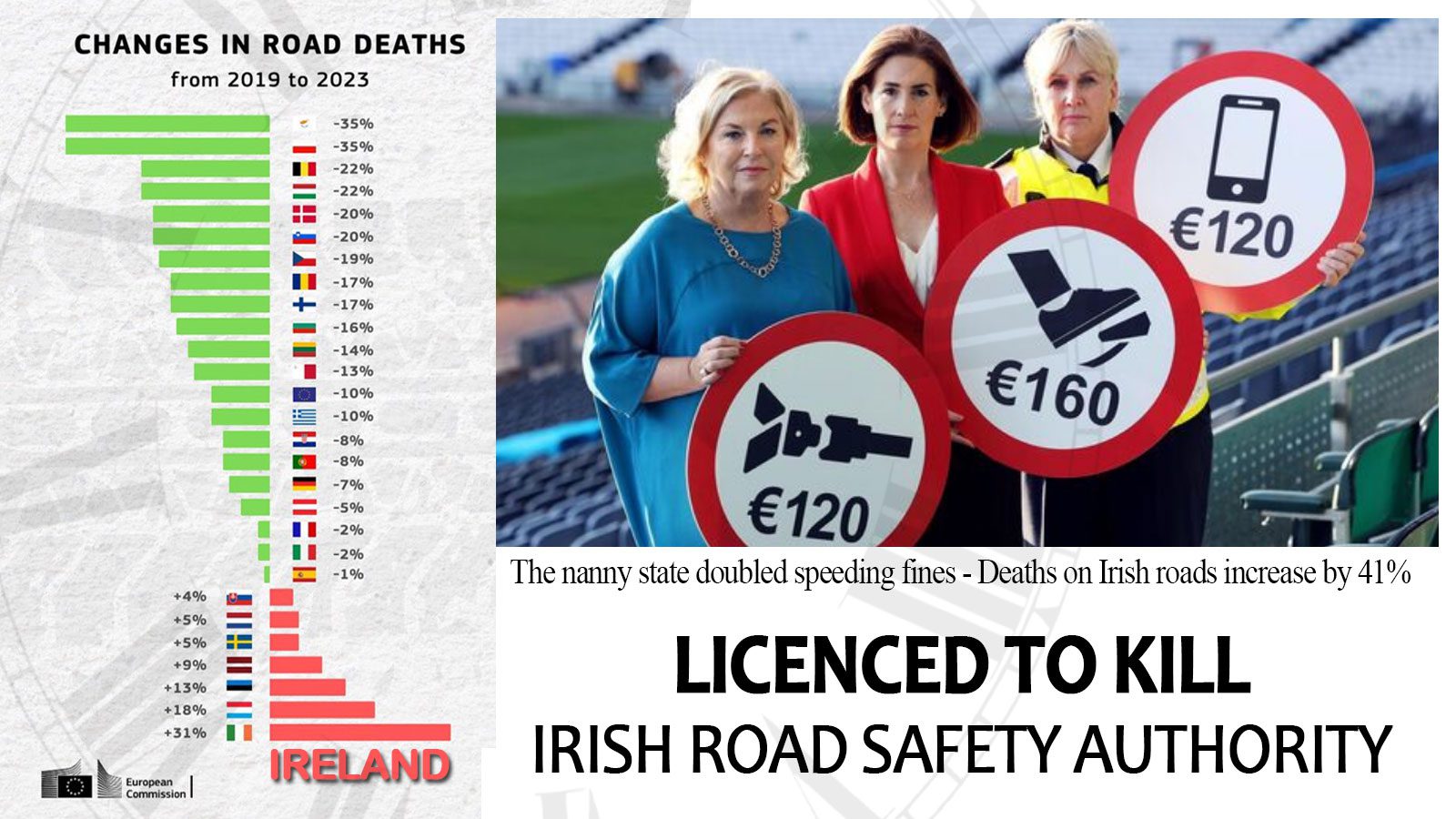
Hildegard Naughton, the then Minister for State at the Department of Transport, doubled speeding fines in October 2022. The effect? The number of road deaths rose substantially. Beware of matronising and cluless politicians.
EJ
Refs
Garda Figures
Number of road deaths rising faster in Ireland than in any other European country
The Irish Road Safety Authority (RSA) was set up to fail and has proved its impotence through the recent rise Read more
The term “clusterfuck” was not coined to describe the Irish civil service — but you’d be forgiven for thinking it Read more
The Irish government has long perfected the perverse tradition of appointing the worst possible person for the job — not Read more
