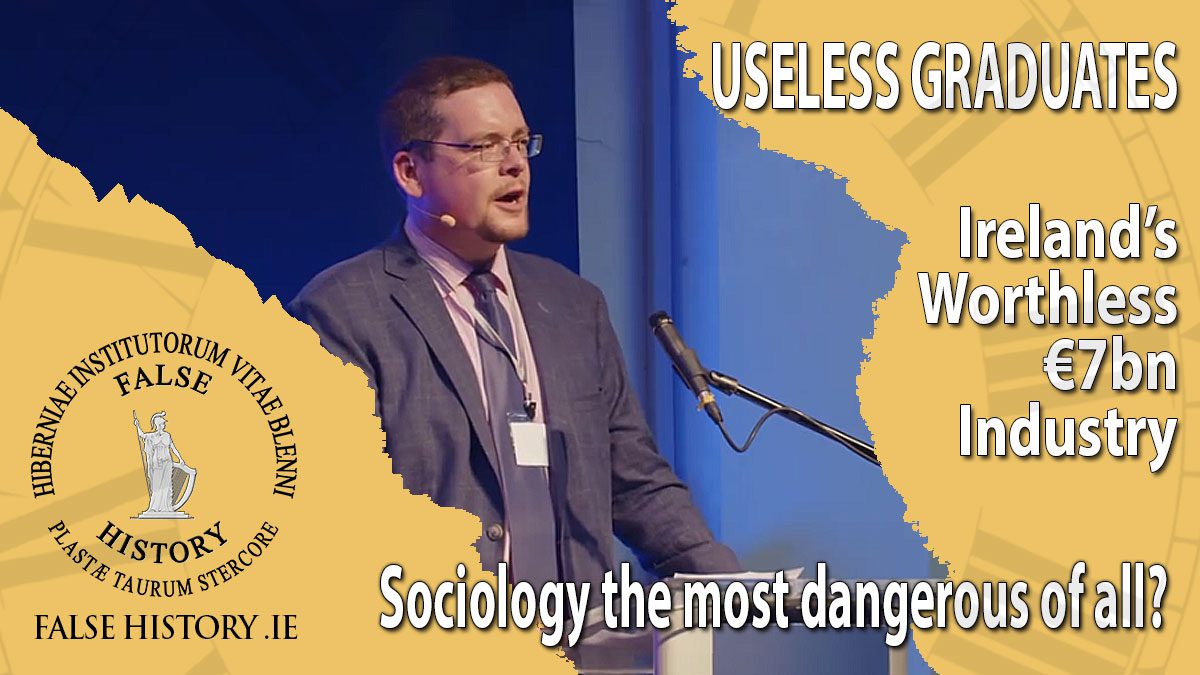
John McGuirk, speaking at the recent Ireland Uncensored event, blamed Ireland’s growing governmental nannyism and numptyism on the ‘useless graduate’. He explained that these are people with arts degrees, with no hard skills, but they got a degree in sociology. While he singled out sociology degrees, he caught himself mid-sentence and broadened the critique to “a degree in whatever.” McGuirk’s comments echo a growing realisation, across these Islands, that the universities are producing graduates of little skill and ability. The British Prime Minister, Rishi Sunak, only a month previous, promised a ‘crack-down’ on worthless university degrees. Will such a crack-down happen here in Ireland?
The NGO Industrial Complex
McGuirk offers a compelling answer. Since Ireland introduced free third-level education in 1994, the Non-Governmental Organisation (NGO) sector has ballooned into an €8 billion industry. He likens it to a “Common Agricultural Policy for Dublin 4”, a reference to the fact that virtually all these organizations receive substantial government funding. According to McGuirk, they are designed to fail, incapable of solving the problems they were created to address.
The Sociology Problem
The critique of sociology as an academic discipline deserves examination. Unlike hard sciences, sociology studies human societies through theories that cannot be empirically validated. It is classified as a rational discourse rather than a science. Without impartial validation tools, questionable theories can gain academic legitimacy. Students spend years deciphering the often contradictory writings of Karl Marx, Émile Durkheim, and Max Weber, 19th-century thinkers whose theories, while historically significant, may have limited practical application.
Real-World Consequences
The consequences of this academic approach extend far beyond university walls. Social work provides a stark example. Despite the misleading name, social workers don’t work on societies, they work with individuals and families in crisis. Yet a master’s degree in sociology is required for the role. The theories of Marx, Durkheim, and Weber don’t apply to individual family dynamics, nor does essay-writing ability translate into practical crisis intervention skills.
The tragic results speak for themselves. The long list of children abused and murdered while under social workers’ care stands as damning evidence. Twenty years ago, after a toddler’s murder in Britain, an investigation report blamed social workers’ training for being “too academic.”
Institutional Failures
The problem extends beyond NGOs. Tusla, the government’s child and family agency, is staffed with graduates whose training may not match the practical demands of their work. Government agencies like the HSE (health) and CAMHS (child mental health) have been described as “catastrophic” in investigative report after investigative report. The HSE’s recent record is particularly alarming: more than 3,000 accidental deaths in five years, with a further 480,000 incidents that could have caused patient harm.
The Resource Excuse
The standard response to these failures is always the same: “lack of resources.” The implication is that more funding will solve the problems. Yet Tusla receives increasing funding every year without resolving its competence crisis. The same pattern repeats across the HSE and other state institutions.
This excuse persists because it exploits a weakness in the political class. Politicians eagerly claim credit for securing funding, it validates their usefulness and, they believe, greases the wheels toward re-election. Part of the solution is recognizing politicians who tout funding as achievement and voting for alternatives.
A Deeper Problem: Contempt for Citizens
As McGuirk points out, there’s a more troubling issue at play: the political class appears to hold the governed in contempt. The message is clear: “You eat too much, you drink too much, you drive too fast, you use the wrong heating. You say the wrong things, you think the wrong things.”
The poor and working poor bear the brunt of poorly conceived policies. Consider minimum unit pricing for alcohol. Families of alcoholics have been left destitute because policymakers failed to grasp a basic truth: addicts will get their fix regardless of cost. Much of Dublin’s crime is drug-related, creating a wasteland of addicts committing crimes to fund their habits.
Rather than developing effective strategies to reduce these problems, the Irish government often makes them worse, then funds an NGO to partially alleviate the misery it created. These NGOs employ staff on generous salaries, many of them, predictably, ‘useless graduates.’
Beyond Sociology
McGuirk defines a ‘useless graduate’ as “not a doctor, not an engineer, and not a scientist,” implying these professions produce more capable people. However, professional degrees don’t guarantee competence. Every profession contains brilliant minds alongside what Americans call “book-smarts”, people who are academically competent but practically inept in the real world.
The challenge facing Ireland isn’t simply about which degrees universities offer. It’s about whether higher education produces graduates capable of solving real problems, serving vulnerable populations effectively, and governing with both competence and respect for citizens.
John McGuirk is the Editor of Gript.
EJ
References
Video: Ireland Uncensored
Over 3,000 fatalities caused by accidents within the HSE since 2018 – Published Aug 21, 2023
The reliance on State funding poses challenging questions for all charities
Ireland’s greatest economic failing: poor public services
Rishi Sunak is right about worthless university degrees
Numpty
Tusla failed to refer 365 cases of suspected child abuse to Garda
Welcome to the Republic of Higher Education, that wondrous archipelago of gleaming glass buildings and tumescent salaries, where Ireland’s brightest Read more

Poor quality thinking is much in evidence these days, especially in the media, both traditional and non-traditional. One recent exemplar Read more
Despite newspaper reports that Ireland was once a ‘deeply misogynistic’ society, the word makes only one appearance in the commission’s Read more
