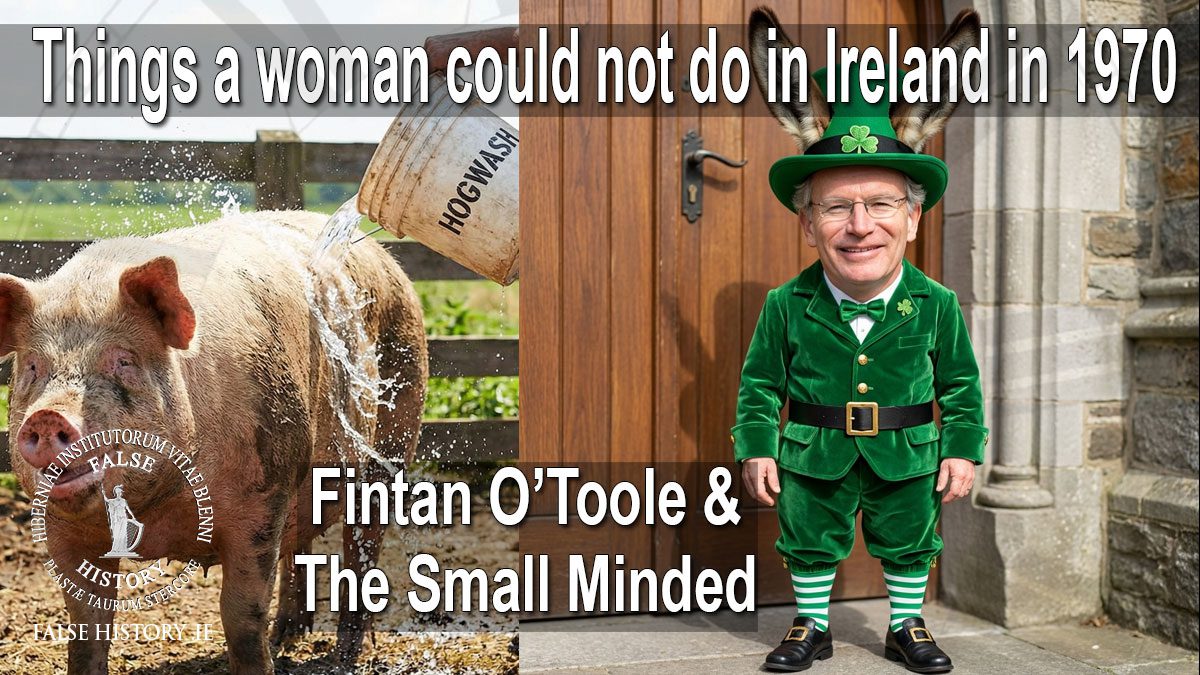
Fintan O’Toole, Ireland’s most professionally aggrieved commentator, chief gaslighter of the Irish, once produced a list of things an Irish woman was allegedly forbidden to do in 1970. The list has been endlessly recycled, rarely interrogated, and never compared. That omission is not accidental.
The purpose of the exercise is not historical clarity but ritual self-denigration: a familiar sneer at Ireland, delivered with the weary confidence of a man who mistakes repetition for proof. Context is carefully withheld. Comparison is quietly banned. Britain, the legal parent of most of these rules, is never mentioned, as if Irish law had emerged spontaneously from bog mist rather than from the same common-law womb.
What is striking is not the list itself, but the silence surrounding it. No one in the commentariat ever asks the obvious, fatal question: how unusual was any of this in 1970? The answer, when examined, is deeply inconvenient. On almost every item, Britain stood in broadly the same position, sometimes worse, often no better, and only rarely ahead in a meaningful sense.
But comparison would ruin the performance. It would expose the list for what it is: an exercise in moral laundering, where later reforms are projected backwards to manufacture a uniquely Irish depravity that never quite existed. This is not history; it is national flagellation with footnotes omitted.
In that sense, the list tells us far more about the habits of Ireland’s opinion-class than it does about Ireland in 1970. Their “we” is always everyone else, never themselves.
1. Keep her job in the public service or a bank after marriage
Ireland (1970)
True for much of the public service and the banking sector
- Women were never barred from by legislation from working in the private sector.
- It was designed so that as many households as possible could benefit from a state income. Also to make room for young women coming on to the jobs market.
- The marriage bar applied to certain grades and in parts of the civil service and many banks.
- It was already politically contested and nearing abolition (ended 1973).
Britain (1970)
Largely the same in practice
- No universal statutory marriage bar, but:
- the civil service had only recently relaxed it (1950s–60s),
- banks, teaching, and private employers still commonly imposed it.
- Married women could be lawfully dismissed in many sectors.
Verdict: Difference of degree, not kind. Britain was only slightly ahead, and mostly by custom, not by right.
2. Sit on a jury
Ireland (1970)
Women were never banned from sitting on juries in Ireland.
At first in 1924 women were allowed to opt out of jury service. Later in 1927 the legislation confirms that women were entitled to sit on juries and could opt in, along with several other categories of professionals
Britain (1970)
Effectively the same
- Law inherited from Britain
Verdict: Functionally similar in both countries.
3. Buying contraceptives
Ireland (1970)
Restricted
- Sale and importation constrained by law.
- However, doctors prescribed the contraceptive pill to thousands of women since it became available in the early 1960s. While it could not be prescribed as a contraceptive, there was no restriction on its use as a “cycle regulator”. If a woman wanted to go on the contraceptive pill in Ireland all she had to do was tell the doctor she was having trouble with her periods.
Britain (1970)
Legal but uneven
- Available on the NHS mainly to married women,
- access for single women depended on local doctors and clinics.
Verdict: Britain slightly ahead legally — but not the sexual free-for-all people imagine.
4. Drinking a pint in a pub
Ireland (1970)
Socially discouraged, sometimes restricted by licence conditions
- Women could drink in “snugs” and ladies’ lounges were common.
Britain (1970)
Exactly the same
- Many pubs:
- refused women service at the bar,
- confined them to separate rooms.
- This lasted into the 1980s in parts of England.
Verdict: Cultural British norm, not an Irish peculiarity.
5. Collecting her children’s allowance
Ireland (1970)
Often paid to the husband
- Household-head model prevailed.
Britain (1970)
Exactly the same
- Child benefit replaced family allowance only later.
- Payment to fathers was standard.
Verdict: Identical welfare logic.
6. Getting a barring order against a violent partner
Ireland (1970)
No general mechanism
- Assault law existed,
- exclusion from the home did not.
Britain (1970)
Also, no effective mechanism
- No general power to bar a husband from the home.
- Meaningful exclusion orders arrive 1976.
Verdict: This claim fails completely as a comparative argument.
7. Living securely in her family home
Ireland (1970)
No automatic right if she didn’t own the property
- Occupation was derivative.
Britain (1970)
The same
- “Home rights” legislation was still new and limited.
- No absolute protection from exclusion.
Verdict: Britain does not offer a historical counterexample.
8. Refusing sex within marriage
Ireland (1970)
No explicit recognition of marital rape
Britain (1970)
Also no recognition
- Marital rape exemption remained until 1991.
Verdict: Britain was worse, not better, on paper.
9. Choosing her official place of domicile
Ireland (1970)
Married women’s domicile followed the husband
Britain (1970)
Exactly the same
- Independent domicile for married women arrives in the 1970s.
Verdict: Straight common-law inheritance from England.
10. Equal pay for the same job
Ireland (1970)
Not guaranteed
- Change driven by EEC membership in the 1970s.
Britain (1970)
Equal Pay Act passed in 1970 — but not implemented yet
- Took effect mid-1970s.
- Large loopholes remained.
Verdict: Britain legislated earlier, benefited later.
Summary Table (1970)
Issue | Ireland | Britain |
Marriage bar | Yes (certain grades in civil service) | Common in practice |
Jury service | Optional | Rare |
Contraceptives | Restricted | Limited |
Pub drinking | Discouraged | Discouraged |
Child allowance | Paid to father | Paid to father |
Barring orders | No | No |
Home security | No absolute right | No absolute right |
Marital consent | Not recognised | Not recognised |
Domicile | Husband’s | Husband’s |
Equal pay | Not yet | Legislated, not delivered |
Bottom line
In 1970, Irish women were not living under a uniquely reactionary legal regime. They were living under a common-law, breadwinner-state model shared almost entirely with Britain.
The narrative that Ireland was a special case of misogynistic abuse depends on:
- suppressing the British comparison,
- laundering later reforms backwards,
- and treating timing differences as moral gulfs.
EJ
A selection of hogwash publications with the Irish self-loathing agenda.
r/IrishHistory 2024 – Ten things an Irish woman could not do in 1970
Irish Central 2017 – Things that Irish women could not do in 1970s
Galway Advertiser, Thu, Dec 13, 2012 – Ten things an Irish woman could not do in 1970
