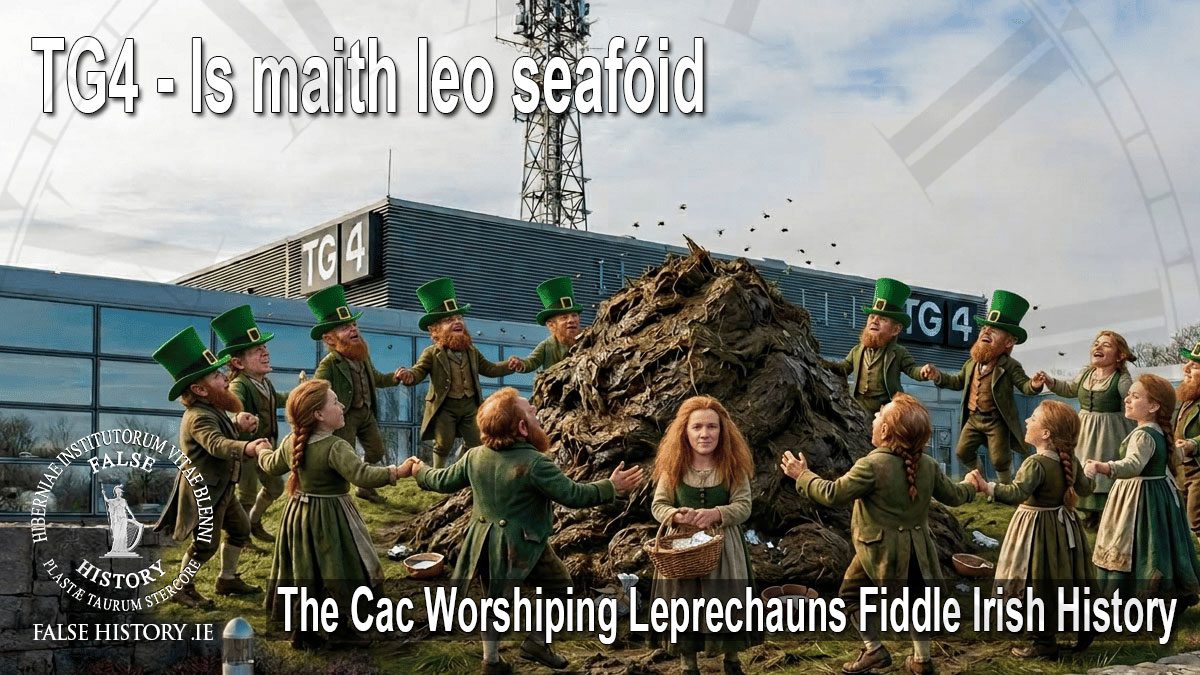
Last night, TG4 once again set about rewiring Irish history, offering up a version of the past shaped less by scholarship than by a kind of barstool antiquarianism with subtitles. And, as ever, the programme’s favourite effigy to burn was the late Archbishop of Dublin, John Charles McQuaid.
Is breá leo an cac tarbh chomh mór sin go gcuireann siad faoi chluasa é chun an fhírinne a choinneáil amach.
McQuaid has become a convenient pantomime villain, largely because his reputation was first dragged through the mud by Dr. Noel Browne, one of the most unreliable narrators in twentieth‑century Irish public life. Browne’s highly selective memoir carved out a moral melodrama in which McQuaid played the arch‑reactionary foil, and ever since, a generation of half‑read commentators has repeated the caricature with unearned confidence and remarkably little historical curiosity.
The result is a lopsided narrative in which McQuaid’s influence on government is wildly overstated, his motives are presumed rather than examined, and his achievements are either forgotten or dismissed as ideological window‑dressing. Almost none of these modern retellings make the slightest attempt to balance criticism with context, nor to analyse, let alone acknowledge, the substantive social, medical, and institutional work he actually accomplished.
So, in the interest of restoring a measure of proportion, and rescuing the historical record from yet another round of performative outrage, here is a brief outline of some of McQuaid’s real contributions, the ones that rarely make it into the script.
Rescuing the Forgotten Social Legacy of Archbishop John Charles McQuaid
By Eugene Jordan
Public discourse in Ireland has long preferred morality tales to complex histories. Few figures have been flattened more completely into monochrome villainy than Archbishop John Charles McQuaid, whose public image today is dominated by controversies, real and exaggerated, surrounding censorship, education, and the Mother and Child Scheme. Yet recent reassessments have shown that McQuaid’s social, medical, and cultural contributions were significant, often innovative, and crucial to the welfare of mid‑twentieth‑century Ireland. This article briefly re‑examines his record through the prism of new scholarship and archival‑based commentary, restoring to visibility a substantial humanitarian legacy obscured by the polemics of later decades.
I. Social Welfare and the Emergency: Building Dublin’s Safety Net
Upon assuming office in 1940, McQuaid faced a capital city strained by wartime shortages, unemployment, and widespread deprivation. His response was both energetic and institutionally creative. Within two years he founded the Catholic Social Service Conference, designed to alleviate the acute poverty and distress that defined the Emergency years.¹ He also established the Catholic Social Welfare Bureau, which assisted not only Dublin’s poor but the thousands of Irish workers travelling to Britain for wartime labour.² These initiatives endured beyond the Emergency period, functioning as de facto social‑care agencies at a time when the Irish State’s welfare infrastructure remained in its infancy. Contrary to later depictions of McQuaid as inward‑looking or authoritarian, the archival evidence presented in recent studies demonstrates that his early episcopate was marked by sustained engagement with the social realities of the capital.³ The organisations he created supplied food, clothing, shelter, employment help, and spiritual support, the material components of social protection in a period before the emergence of statutory welfare. Their continuing relevance after 1945 is a measure of the structural gaps they were designed to fill.
II. A Pioneer in Emigrant Welfare: An Overlooked National Contribution
One of the least appreciated aspects of McQuaid’s legacy is his pioneering work on the welfare of Irish emigrants in Britain. According to the National Library of Ireland’s 2023 Hedge School reassessment, McQuaid played a central role in building support networks for Irish migrants during the mid‑century exodus.⁴ At a time when the Irish State provided virtually no institutional support to its emigrants, McQuaid coordinated pastoral, social, and practical aid for those arriving in British cities. This assistance, delivered through parish networks, chaplaincies, and diocesan structures, addressed concrete problems: unemployment, homelessness, loneliness, religious accommodation, and poverty. The significance of this work is twofold. First, it reveals McQuaid as one of the earliest architects of structured Irish diaspora welfare. Second, it complicates the myth of the “clericalist reactionary,” positioning him as an innovator operating in a transnational social field.⁵ His emigrant support programmes were decades ahead of State policy and represent a substantial contribution to Irish social history.
III. Public Health Initiatives: Clinics, Care, and Medical Ethos
While McQuaid is frequently linked in popular discourse with the Mother and Child debate, historians now recognise that he played a much broader role in public health. As Mary Kenny’s recent reassessment notes, McQuaid helped establish clinics for tuberculosis and sexually transmitted diseases, both of which were major public health challenges in 1940s and 1950s Ireland.⁶ These clinics were not token gestures. TB was endemic and lethal; venereal disease was widespread and heavily stigmatised. McQuaid’s support for such institutions reflects not only his medical family background but his commitment to the physical as well as spiritual wellbeing of the population. That these ventures have been minimised or ignored in popular treatments of his legacy reflects historiographical selectivity rather than evidence.
IV. Culture, Architecture, and the Built Environment
McQuaid’s influence extended well beyond social welfare and public health. As the Dictionary of Irish Biography documents, he was a discerning patron of the arts, supporting major Irish figures such as Michael Healy, Evie Hone, and Mainie Jellett.⁷ These commissions enriched both ecclesiastical and civic culture, and they demonstrate McQuaid’s investment in raising artistic standards in mid‑century Dublin. His cultural engagement intersected with a broader involvement in architecture and urban planning. The 2023 History Ireland panel highlights his influence on Dublin’s built environment and his interest in shaping the physical as well as moral life of the city.⁸ Far from being an insular ecclesiastical conservative, McQuaid participated in debates about urban development and cultural modernisation, challenging once again the reductionist stereotypes that dominate popular memory.
V. Why We Forgot: The Politics of Memory and the Browne Narrative
The erasure of McQuaid’s constructive achievements cannot be understood outside the politics of memory that crystallised from the 1970s onward. Key to this was the publication of Noel Browne’s memoir Against the Tide, which cast McQuaid as the chief antagonist in a personal drama of political martyrdom. The book itself is chiefly remarkable for its dishonesty. However, it was later influential in cultural and academic narratives, focusing heavily on issues of censorship, sexuality, and Church‑State relations, absorbed and amplified this frame. Yet, as the History Ireland and NLI reassessments emphasise, this popular image reflects selective remembering, rather than a balanced appraisal of the evidence.⁹ A more serious historical method, one attentive to archival complexity, reveals a figure who was far more socially engaged, institutionally creative, and civic‑minded than the current caricature allows.
Conclusion: Toward a More Honest National Memory
No historical reassessment should obscure McQuaid’s mistakes or blind spots. But neither should it tolerate the flattening of a complex legacy into a single negative trope. The evidence, social, medical, administrative, and cultural, demands recognition of McQuaid as a major builder of Irish civil society, whose contributions to welfare, health, emigrant support, and culture were substantial and enduring.
Recovering this fuller picture is not revisionism. It is historical accuracy, and the beginning of a more mature engagement with the Ireland of our past.