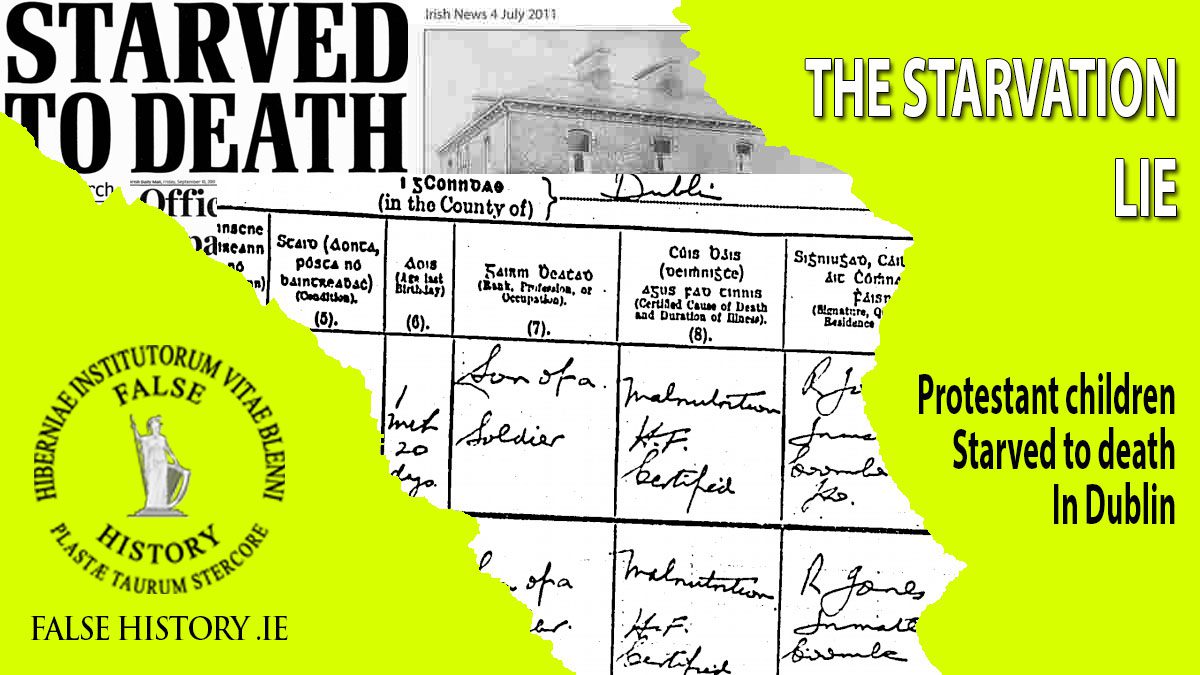
The central falsehood underpinning the so‑called mother and baby homes scandal is the claim that infants were deliberately starved to death. This allegation rests almost entirely on a limited number of death certificates that record the cause of death as marasmus. To present marasmus as evidence of starvation is a gross distortion of medical reality.
Marasmus is a recognised clinical condition associated primarily with severe illness, congenital abnormalities, chronic infection, or failure to thrive. It was a diagnosis commonly recorded in the early twentieth century across all medical settings where frail or seriously ill infants were treated. To assert that it is synonymous with intentional starvation is not merely misleading, it is demonstrably false.
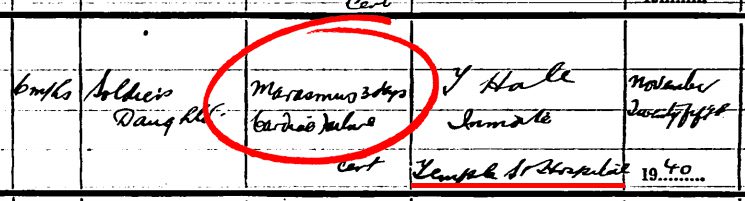
The evidence refuting the starvation narrative is extensive. Identical causes of death appear repeatedly in the records of Irish maternity hospitals, paediatric hospitals, private nursing homes, and family residences throughout the country. The samples reproduced below include death registrations from the Rotunda Hospital and Temple Street Children’s Hospital in Dublin, institutions never accused of systematic neglect or murder. Yet the same diagnosis “marasmus” appears just as frequently in their records.
This raises an obvious and unavoidable question: why are these hospitals not accused of running starvation regimes or murdering infants? The selective outrage exposes the argument’s fundamental weakness. The diagnosis is treated as neutral medical terminology in one context and transformed into evidence of criminal intent in another, depending entirely on the desired narrative.
When the documentary record is examined honestly, it becomes clear that marasmus was a tragic but common outcome in an era before antibiotics, neonatal intensive care, or modern nutritional science. It is not, and never was, a coded admission of starvation.
The Commission of Investigation into Mother and Baby Homes has itself acknowledged this reality. Its final report explicitly dismantles the simplistic and emotive claims made by commentators who have substituted rhetoric for evidence. The relevant excerpt below makes clear that the presence of marasmus in death records cannot be used to support allegations of deliberate neglect or mistreatment.
The historical record does not support the scandal narrative. Only a refusal to engage with medical facts, comparative evidence, and primary sources allows it to survive at all.
Once the evidence is placed on the record, it is plain that marasmus does not denote starvation. The Commission of Investigation into Mother and Baby Homes has further dismantled the claims of these commentators, revealing them to be based on ignorance rather than evidence. The following excerpt from the final report is directly relevant.
33.5 Some commentators have concluded that infant deaths which occurred in mother and baby homes due to marasmus indicates that infants were neglected, not appropriately cared for, and/or wilfully starved to death in these institutions.
However, marasmus was a frequently cited cause of infant deaths in institutional, hospital and community settings in early twentieth-century Ireland. The Commission considers it unlikely that deaths in hospitals and family homes were due to wilful neglect and so cannot conclude that the term marasmus denotes wilful neglect in mother and baby homes. The more likely explanation is that marasmus as a cause of death was cited when an infant failed to thrive due to malabsorption of essential nutrients due to an underlying, undiagnosed medical condition.
Deaths attributed to marasmus appear in the records of every maternity hospital in Ireland. Yet only institutions operated by religious orders were singled out for allegations of deliberately starving infants to death. These were also the only bodies subjected to a standalone Commission of Investigation. This narrow focus, despite identical medical evidence across secular and religious institutions, raises serious questions about selectivity and motivation.
It is this disparity, rather than any new medical or historical discovery, that necessitates the book’s title and the chapter devoted to rebutting these accusations. The claims were not grounded in paediatric science or contemporary clinical understanding, but were instead asserted repeatedly in political and media discourse.
The article [click here] illustrates the nature of allegations made by Irish politicians and allows readers to judge for themselves the extent to which those claims were informed by medical expertise. The excerpts are drawn directly from the parliamentary record.
Why were these hospitals not investigated and accused of starving babies to death?

The Irish Attack on Christianity – The Case for the Defence
A new book takes an empirical look at the mother and baby homes scandal and others in what the author claims to be Ireland’s greatest history scandal. A scandal founded upon false allegations, bad history and incompetent statistical interpretation. It drew its oxygen from populism, cultural biases and the prospect of compensation, and it grew into a triumph for ignorance. Babies were not starved to death by religious women, women were not banned from sitting on juries, nor were they banned from doing work ‘unsuited to their sex’ nor did the state create a ‘brutal carceral’ system to confine wayward women. The underlying causes of the mother and baby homes scandal have been allowed to fester for decades due to a breakdown in the quality control systems in academic history. The aim of the book is to apply the quality control methods which should have been in use and seek to discover the reasons for their failure.
