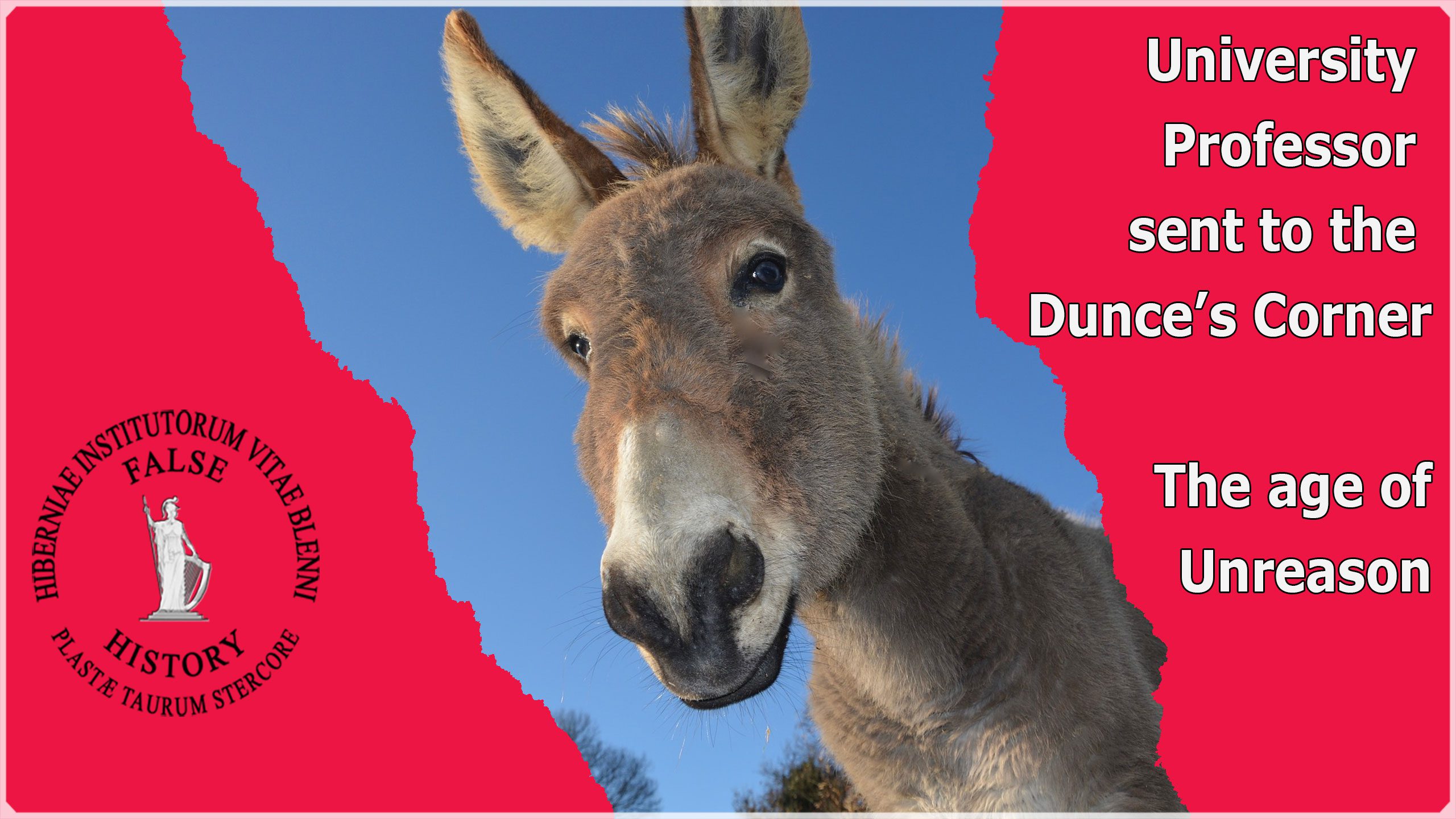
Professor Chris Fitzpatrick’s Irish Times article of 13 October 2020 is remarkable, not for its predictable distortion of historical events, but for its illusory sense of superiority.
Fitzpatrick asserts that “in the annals of medical history, it’s rare to come across a medical student who sets out to kill another person.” This is demonstrably false. Fitzpatrick, as one might guess, is a professor of medicine, not of history. His claim is emblematic of a genre I call Irish barstool history: a pseudohistory absorbed while perched on or collapsed beneath a barstool, listening to a drunken leprechaun pontificate on social status by denigrating others.
In this article, Fitzpatrick sets out to denigrate Kevin Barry, a medical student who joined the Irish War of Independence, was captured, tortured, and executed by the British on 1 November 1920. He was only 18 years old. His hanging made global headlines; his youth and sacrifice turned him into a symbol of freedom. A ballad commemorating Barry appeared soon after and has been covered by countless artists, including Leonard Cohen.
Barry was not alone. Numerous medical students, such as Ernie O’Malley and James Ryan, took up arms during the struggle for independence. Both returned to complete their studies; Ryan later became Ireland’s first Minister for Health. By Fitzpatrick’s logic, they too “set out to kill another person.” Internationally, history is replete with doctors who fought, and killed, in wars. At the Nuremberg Trials, seven physicians were executed and ten imprisoned for atrocities. Josef Mengele, the most sadistic of them all, escaped justice. Che Guevara, another trained medic, became a revolutionary icon. Even today, army medics worldwide are armed and trained as soldiers.
Consider also the grim roll call of doctors who became serial killers: Michael Swango, the “Poison Doctor”; Harold Shipman, with 236 victims; Marcel Petiot, “Doctor Satan,” who admitted to killing 60 people before his execution in 1946. These cases suggest that the medical profession may harbour a statistically disproportionate number of killers compared to other fields. One truth is undeniable: medical students, doctors, and professors are human, fallible, flawed, and sometimes lethal. A medical degree does not confer moral superiority.
Fitzpatrick compounds his sanctimony by recycling the tired canard that the Christian Brothers taught him “jihad” long before he encountered the word. In reality, Irish schools taught a state-approved curriculum, not holy war. The Catholic Church, far from endorsing violence, excommunicated every republican combatant during the Civil War. The historical record of British rule in Ireland is one of brutality, sectarianism, and economic vandalism. Anyone taught that truth will not emerge enamoured of Britain; indeed, the Irish government diluted history teaching in the 1950s for fear it was fuelling IRA recruitment. Yet the savagery inflicted by Britain cannot be denied. It should be remembered, not to perpetuate hatred, but to measure how far society has progressed since the partial retreat of an abusive superpower.
Certain Irish families and social strata have long aligned with Britain, using pseudohistory to bolster illusions of status, achieved by denigrating others. Fitzpatrick, despite his lofty academic perch, merely echoes the well-worn sneers of the Seoníns and Jackeens: derogatory terms for Irish Anglophiles, the latter aimed at Dubliners enamoured of the Union Jack.
Fitzpatrick offers nothing new to Irish historiography. What stands out is the ignorance of his diatribe, a symptom of how far standards have fallen in Irish academia.
And for the record, Professor: The Troubles did not begin with an IRA campaign. They were ignited by loyalists, Irish people who considered themselves British. The first bombs were planted by the UVF in 1969, targeting sites in Dublin and beyond: the Garda detective bureau, RTÉ studios, the O’Connell Monument, the Wolfe Tone memorial, and the Ballyshannon power station. These attacks coincided with loyalist mobs burning Catholic homes and businesses, prompting the formation of the Provisional IRA in December 1969 to defend civilians. Even the British Army was deployed to protect Catholic areas. The IRA’s offensive against British rule did not commence until 1971, two years after loyalist paramilitaries had bombed schools, substations, and railways across Ireland.
The first RUC officer killed was shot by loyalists, a botched hit intended for a Catholic colleague. Blunders were endemic: in 1971, a UVF squad ordered to bomb an IRA pub balked at the risk and instead targeted a nearby bar, killing 15 innocent people, the highest single-incident death toll in Belfast during the Troubles.
The truth is clear: The Troubles did not start with the IRA. It is time the ignorant barstool historians who peddle such myths were shown the door, preferably before they stagger back to the college bar.
EJ
A dunce’s corner was a form of punishment used by teachers of the past. Pupils who gave wrong answers to the teacher’s questions were labelled a dunce, a synonym of simpleton, and were made to go and stand in the corner of the classroom. Sometimes children were forced to wear a conical shaped hat called the dunce’s hat. If any teacher carried out such punishments today, it would be labelled child abuse.
Original article from the Irish Times website.
‘Chris Fitzpatrick: It is wrong to commemorate Kevin Barry’
https://www.irishtimes.com/opinion/chris-fitzpatrick-it-is-wrong-to-commemorate-kevin-barry-1.4379523

Michael McDowell assumed his role as the Joseph Goebbels of anti-Catholic Ireland. The country’s biggest eejit had to apologise for Read more
Many academics were made to look foolish because the final report of the commission of investigation into mother and baby Read more
The gross hypocrisy of An Taoiseach Micheál Martin might not be immediately discernible from his the quote below, spoken at Read more
The commission of investigation into mother and baby homes named the following people for conducting vaccine trials on children without Read more
